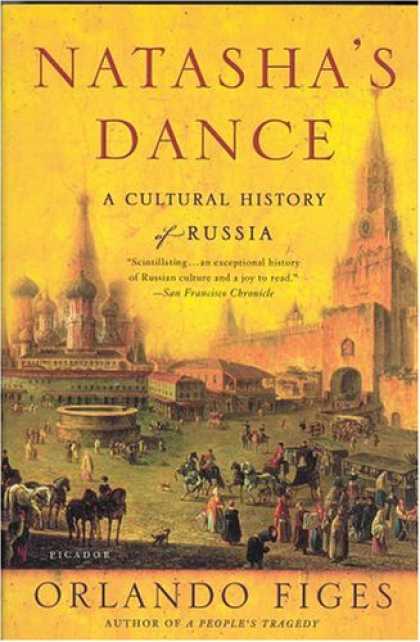
Natasha's Dance

I read this book by Orlando Figes a few years ago, which provides a sweeping view at Russia's cultural history. As Lisa Jardine notes in her Guardian review:

Figes sets out to capture the many-stranded complexity of the idea of cultural 'Russianness'. But this is not just a cultural history, despite Figes's title. His book is especially angled to arouse the interest of those to whom the works of a litany of Russian artists, musicians and authors are already familiar and much-loved, as familiar as the curious Russian-clad figures in Figes's striking photographs are alien. What was it about Russia and its influences that inspired the novels of Tolstoy and Dostoevsky, the plays of Chekhov, the music of Shostakovich and Tchaikovsky, the choreography of Stravinsky, the paintings of Chagall and Kandinsky?

No small task, and I thought Figes did a wonderful job. My wife's older cousin, a drama critic in Moscow, noted that Figes missed a key point here and there, but overall he felt it was a pretty good general history.

What I liked most was the way Figes wove all these strands together, making it feel that in Russia and even to some degree in the later Soviet Union there was a great sense of cultural continuity, arguably beginning with Pushkin's Eugene Onegin. So much of Russian literature is self-referential and the writers, composers and artists all seemed to move within tight circles. There was the odd man out like Dostoevsky or Goncharov, but it was interesting to read how much an influence Pushkin had on Gogol, and how he inspired Gogol to write Dead Souls, one of my personal favorite novels.

Comments

  1. Cool! I bought Natasha's Dance when it came out but never read it. During my first attempt at graduate school I chose Russian history as my "European" option. Even tried (failed) to teach myself to read Russian. I think I was under the spell of Dostoevsky at the time.

    ReplyDelete
  2. I don't think you will be disappointed, av. Very engaging book and cover so much of the Russian cultural scene, with many poignant insights, like the sad story of Mayakovsky as seen through his wife's eyes.

    ReplyDelete
  3. Great movie to check out is "Russian Ark," all set within the Hermitage,

    http://www.imdb.com/title/tt0318034/

    ReplyDelete

Post a Comment

Popular posts from this blog

Myshkin's dilemna

Wrapped up Part II the other night and have to say that Dostoevsky certainly has a comic's eye, although one senses the potentially tragic undertones.  For Dostoevsky the aristocracy seems to be one largely made up of capricious souls more obsessed with good manners than any profound sense of their being.  This is particularly true for the Epanchins, who comically wrestle with their emotions in one scene after another as he places them in very odd and unnerving situations that test the limits of poor Lizaveta Prokofyevna's endurance. Of her daughters, Aglaya, is the most interesting.  A real beauty much along the same lines as Nastasya Filippovna Barashkov, who likewise seems to have a hold on Prince Myshkin's emotional strings.  Part II ended with Lizaveta demanding to know the extent of the Prince's interests in her youngest daughter.  The Prince insisted his feelings were Platonic, but one senses there is more to be said on the matter in later chapters. ...

Ward No. 6

Ward No. 6 is a short story written by Chekhov in 1892.  It has appeared in various collections of Chekhov short stories, including The Horse-Stealers and Other Stories translated by Constance Garnett in 1921.  In this story, Chekhov explores the inner working of a run-down lunatic asylum in a provincial town.  He  introduces the readers to a coarse porter who speaks mostly with his fists, various patients, a doctor who presides over this ward, and expresses his thoughts with a local postmaster.  It was recently made into a movie , featuring Vladimir Ilyin.  Here's a clip . There's also this very recent short film (30 min.) by Suzana Purkovic, with English subtitles.

Roadside Picnic: Life inside the Zone

If you're like me and wondered what the hell Stalker was all about, I would suggest reading Roadside Picnic , the book on which it was nominally based.  Tarkovsky took his idea from the character, Redrick Schuhart, a laboratory assistant and Harmont Branch of the International Institute of Extraterrestrial Cultures, leaving the rest up to the imagination.  The names were changed to protect the innocent. While Tarkovsky chose to shroud the story in mystery, the Strugatsky Brothers lay it out pretty clearly in their science fiction classic.  Redrick, the Stalker, has gone into the zone countless times but each time represents a new set of challenges, especially with the Harmont Branch cracking down on the plundering of alien objects left behind by a visitation to a small rural town in Canada. I suppose setting the story in a place outside Russia, allowed the Strugatsky brothers more room to explore new ideas and avoid heavy censhorship, but according to Boris in t...